Ruakuri Cave guided walking tour
Cave: Ruakuri Cave, Waitomo
The camera rule differs from tour to tour. Here is where photography is allowed, where it is banned, and what to expect either way.
The short answer
You can take photos on the Ruakuri Cave walking tour at Waitomo, in selected areas and without tripods, and phones and small cameras are welcome on the Off the Beaten Track tour into a private cave. On the Waitomo Glowworm Caves boat tour and in the Te Anau caves, cameras are banned. If long exposures are the point of your trip, the private photography tour near Te Kūiti allows larger cameras and small tripods.
Pick a day, or the first and last day you are near Waitomo, Te Anau or Auckland. We check the booking calendar of each cave tour and show which ones still have places.
In the next 7 days, all 4 tours on this page still have places.
Cave: Ruakuri Cave, Waitomo
Cave: Private farm cave near Waitomo
Duration: 3 h
Cave: Waitomo Glowworm Caves
Duration, photo rule and access for each tour; every card opens to the full details.
The cave where cameras are welcome in selected areas: 1.5 hours among formations and glowworms. Wheelchair and stroller accessible, own transport needed.
The longer Waitomo cave tour, and unlike the boat tour next door it allows photos in selected parts of the cave. Ruakuri is entered through a spiral entrance, and the 1.5-hour tour leads past glowworms, limestone formations and underground rivers.
Ruakuri is also the accessible choice: the walking route is wheelchair and stroller friendly, which the main Glowworm Cave is not. Two practical points: Ruakuri tours start at their own visitor centre on Tumutumu Road, a short drive from the Glowworm Caves visitor centre, and you need your own transport. Arrive on time, too, because latecomers forfeit their ticket without a refund.
Ruakuri Visitor Centre, Tumutumu Road, Waitomo, a short drive from the Waitomo Glowworm Caves Visitor Centre; you need your own transport. Check in 30 minutes before the start.
Taken from the operator's own listing on the booking platform; photo and age rules as stated there.
Small-group caving in a private cave on a family farm: about 2 hours underground, wading, climbing and crouching. Phones welcome, the guide takes photos. Age 12+, own transport.
A small-group trip into a privately owned cave system on a family farm in the Waitomo district, away from the crowds and the developed show caves. After about 15 minutes of preparation and a safety briefing, you walk 10 to 15 minutes through native bush and the Mangapū Gorge to the entrance, then spend around two hours underground: walking, wading through shallow water, climbing over rocks and crouching through smaller sections, with larger chambers and glowworm displays along the way. There are no paved paths or handrails, no boat and no abseiling.
The group is limited to eight people, and caving clothing and boots are provided; afterwards there are showers, tea, coffee and biscuits. Phones and small cameras are welcome, and the guide takes photos of the group that are sent to you afterwards. This is the operator's regular group tour, not to be confused with the same operator's private photography tour. You arrive under your own steam: no transport is offered.
1199 Oparure Road, Te Kūiti (Waitomo district). Arrive 15 minutes early. No transport is offered.
Taken from the operator's own listing on the booking platform; photo and age rules as stated there.
A private 3-hour caving trip with your own photographer-guide near Waitomo. Larger cameras and small tripods allowed. Priced per group of up to four; minimum age 11.
The one glowworm tour here that is built around the camera. On this private trip with your own photographer-guide you photograph inside and outside a glowworm cave in the Waitomo district. Unlike on the walking tours, larger cameras and small tripods are allowed, which is what long exposures of glowworms need.
It is a real caving outing, not a walkway: the operator supplies thermals, a fleece, gumboots, socks, helmet and headlamp, and there are showers and tea, coffee and a snack afterwards. Bring your own camera. The price is per group of up to four people, not per person, and only your group takes part.
1199 Oparure Road, Te Kūiti. The tour ends back at the same place.
Taken from the operator's own listing on the booking platform; photo and age rules as stated there.
The famous boat ride under the grotto, strictly camera-free. Watch it, remember it, buy the souvenir photo if you want one.
The classic New Zealand glowworm experience: a guided walk through the limestone chambers of the Waitomo Glowworm Caves, including Cathedral Cave, followed by a silent boat ride under the glowworm grotto, with thousands of Arachnocampa luminosa lighting the ceiling above you.
Two things to know before you book. The tour is short (45 minutes) and some reviewers feel the ticket is expensive for that length; go in knowing you are paying for a compact, well-run visit, not a half-day underground. And photography is not permitted anywhere inside: cameras and GoPros stay outside, so the grotto is something you watch, not something you film. If taking photos in a glowworm cave matters to you, look at the Ruakuri walking tour instead.
Waitomo Glowworm Caves Visitor Centre, 39 Waitomo Village Road, Waitomo. Check in 30 minutes before the start; the tour ends back at the same place.
Taken from the operator's own listing on the booking platform; photo and age rules as stated there.
If you plan to photograph a glowworm cave in New Zealand, one booking decision matters more than any camera setting: which tour you choose. On the two classic tours, the Waitomo boat tour and the Te Anau caves, cameras are banned outright. In the Waitomo area there are exceptions: the Ruakuri Cave walking tour, where photography is allowed in selected areas of the cave, the Spellbound caves, where Spellbound welcomes cameras and phones, and Down to Earth’s Off the Beaten Track small-group tour into a private cave, where phones and small cameras are welcome.
Even in Ruakuri, where the camera is welcome, temper the expectation: glowworm light is faint, caves are very dark, and without a tripod (tripods are not permitted in Ruakuri) long exposures are hard. One 5-star Ruakuri reviewer puts it well: the glowworms are “not as expansive as some might expect” but still “a breathtaking sight”. Several critical reviews of Ruakuri say the same thing less kindly: fewer glowworms than the marketing photos suggest. Photograph the formations, the spiral entrance and the cave itself; treat a usable glowworm shot as a bonus.
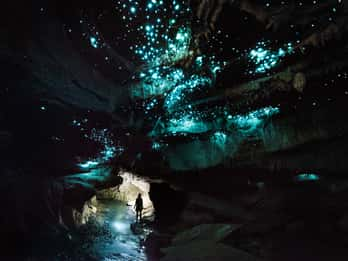
The glowworm threads, the sticky silk lines that the larvae of Arachnocampa luminosa hang to catch prey, are a subject in their own right. The hero image on this page shows them.
If the long exposure is the point of your trip, one tour is built for exactly that: Down to Earth, an operator based near Te Kūiti in the Waitomo district, runs a private three-hour photography tour into a glowworm cave with your own photographer-guide, and on that tour larger cameras and small tripods are allowed. It is a proper caving trip rather than a walkway: thermals, gumboots, helmet and headlamp are supplied, the minimum age is 11, and it is not suitable for anyone with mobility issues or back problems. The price covers a group of up to four people, not one person. Do not confuse it with the same operator’s Off the Beaten Track group tour: that is a regular small-group caving trip of up to eight people, where phones and small cameras are fine but tripods and professional cameras are not.
If photos matter to you, book Ruakuri (alone or alongside the boat tour) or, if you are up for a physical caving trip, Off the Beaten Track. If you only do the boat tour or Te Anau, decide before you go that this one is for watching, not filming. On the Spellbound day trip from Auckland, Spellbound welcomes cameras and phones in its glowworm cave, according to its own website.

Not on the boat tour. Cameras and GoPros are banned throughout, and souvenir photos can be bought instead. The Ruakuri Cave walking tour next door allows photography, and in the wider Waitomo district the Off the Beaten Track small-group tour welcomes phones and small cameras.
No. Cameras are not allowed inside the Te Anau caves. The ban covers the cave system and is strict there, and the visit also asks for complete silence.
The operators state the rule but give no detailed reason on their pages, and we will not invent one. What they do publish: photography and video are not permitted in the Waitomo Glowworm Caves or the Te Anau caves, while the same Waitomo operator allows them in selected areas of Ruakuri, without tripods or extension sticks.
Do not count on it. Glowworm light is faint, caves are dark, and tripods are not allowed on the walking tours. In Ruakuri the formations, the spiral entrance and the glowworms make good subjects; treat a dramatic glow shot as a bonus rather than the goal.
Yes. Down to Earth in the Waitomo district runs two. Its Off the Beaten Track small-group tour (up to eight people, age 12+) welcomes phones and small cameras, and the guide takes photos of the group; tripods and professional cameras are not allowed. Its private three-hour photography tour (only your group, priced per group of up to four) adds your own photographer-guide, and larger cameras and small tripods are allowed there. Spellbound, bookable here as a day trip from Auckland, also welcomes cameras and phones according to its own website, with fixed camera stations in its glowworm cave.
Where photography is banned, the ban covers video too, so the phone stays in your pocket. In Ruakuri, photography and video are permitted in selected areas only; follow your guide's instructions on the day. For Spellbound, the day-trip operator asks you to turn down your screen brightness to protect everyone's night vision.
The glowworm tours with their photo rules, side by side.
See the comparison